Why Your HVAC Estimate Follow-Up Is Costing You Jobs
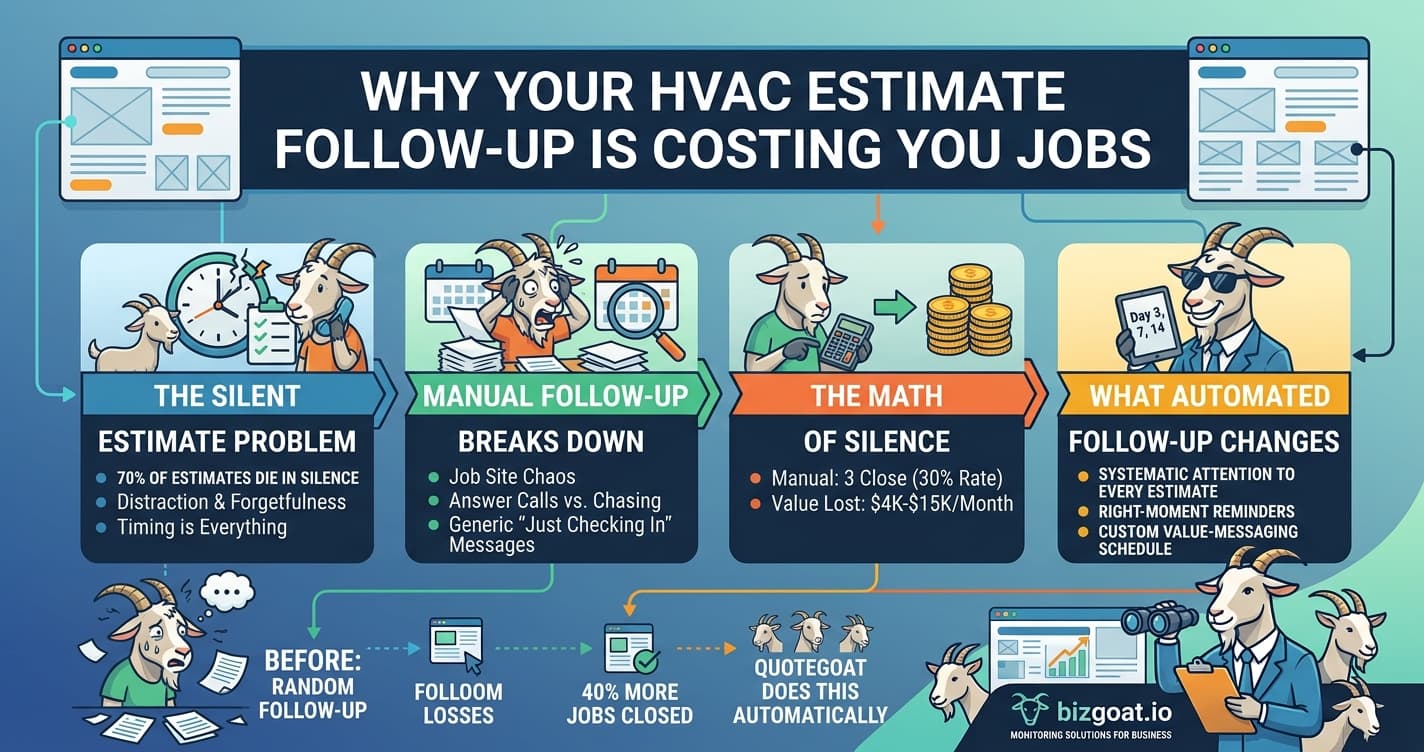
Contractors lose 70% of estimates to silence, not competition. Here's why and how automatic follow-up closes 40% more jobs.
Why Your HVAC Estimate Follow-Up Is Costing You Jobs
You sent 12 estimates last month. Three became jobs. Nine didn't respond.
You might have thought they went with another contractor, and maybe some did. But the truth is messier: they got distracted, your estimate wasn't top of mind when they were ready to hire, or they were comparing you with two other companies and whoever followed up last won.
The Silent Estimate Problem
This is the most expensive problem in contractor services: the estimate that dies in silence.
You spend time on site, diagnose the issue, write up a professional estimate, and send it. Then you wait. If they don't respond in 48 hours, you follow up. Maybe you don't, because you're already scheduling the next job.
Either way, most of those estimates disappear. Not because your price was wrong or your work is bad. Because they needed a reminder, and you didn't give it to them—or you only gave it once.
The data backs this up hard. Contractors who follow up within 24 hours close about 20% of their estimates. Those who wait a week close about 10%. Most contractors follow up once, then move on.
Why Manual Follow-Up Breaks Down
You know you should follow up on every estimate at day 3, day 7, and day 14. But you're running a business.
You're on job sites. You're answering customer calls. You're not sitting at a desk tracking spreadsheets of estimates from last week. So you forget.
Or you remember too late. Or you send a generic "just checking in" message that feels awkward because you're now chasing them down instead of them chasing you.
The Math of the Silent Estimate
Let's say you send 10 estimates a month. You close 3 without any follow-up. That's a 30% close rate.
If you actually followed up systematically on all 10, research shows you'd close around 5 or 6. That's 2 or 3 extra jobs from the same amount of estimating work.
If each job is worth $2,000 to $5,000, that's $4,000 to $15,000 in additional revenue every month. Just from remembering to follow up.
Now imagine doing that for 12 months. That's one or two extra projects per month, entirely from a process that didn't cost you anything except attention.
What Automated Follow-Up Changes
When you set up automatic follow-ups, a few things happen. Every estimate gets the same attention. You're not playing favorites based on whoever you remembered to call.
Second, you're there at the right moment. When they're thinking about the problem again, your follow-up appears. Not a week late. On schedule.
Third, you can include exactly what you want in each message. Day 3: a casual check-in. Day 7: a value reminder. Day 14: a gentle "if you want to move forward, here's how."
Contractors Are Already Winning With This
HVAC companies, electricians, plumbers, and roofers who've switched to automated follow-ups report closing 15-20% more estimates without changing their pricing or service. They're doing the same work, just remembering the follow-ups.
That's your competitive advantage right there.
Make It Automatic
You don't need a complicated CRM. You need something that takes your estimates and handles the follow-up: send a message on day 3, day 7, day 14, all without you logging in.
QuoteGoat does exactly this. You upload an estimate, set your follow-up schedule, and it handles the rest. Your customers get reminded. You close more jobs.
The question isn't whether automated follow-up works. It does. The question is why you're still doing it manually.
If you're serious about protecting your links, your data, and your brand, it's time to stop sharing raw URLs.
Start using Bilt.ly.
Get started free →