What I Learned Monitoring My Competitors' Websites for 30 Days
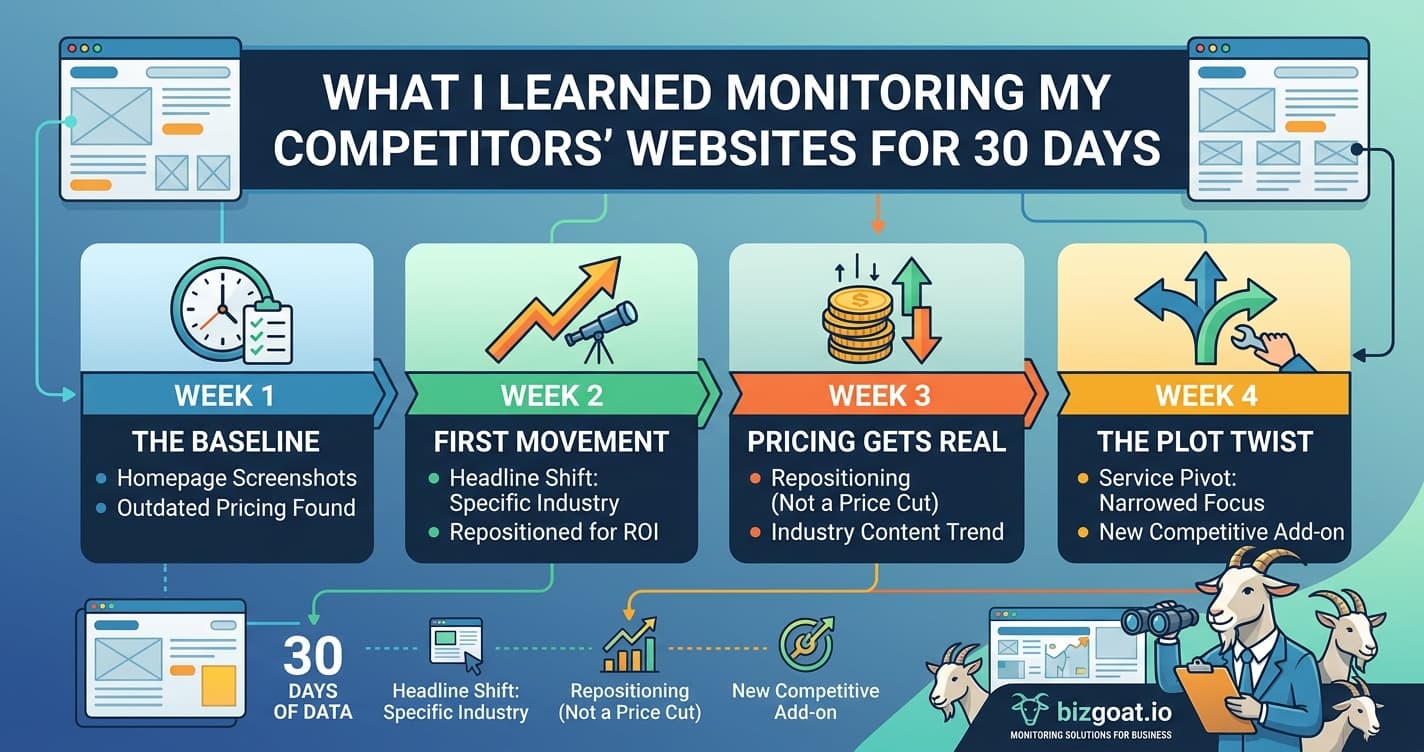
Real data from 30 days of competitor monitoring. Pricing changes, positioning shifts, and market signals you need to see early.
What I Learned Monitoring My Competitors' Websites for 30 Days
I built a competitor monitoring tool because I kept losing deals to price changes I didn't know about until they'd already happened.
So I set up a test. For 30 days, I tracked five direct competitors in my space. Every change got logged. Every new page, every pricing update, every copy revision.
Here's what actually happened.
Week 1: The Baseline
I screenshotted every competitor's homepage. I noted their pricing. I checked their service pages. I looked at the language they were using to describe their value proposition.
I found two of the five had outdated pricing on their websites (listed lower than what they were actually charging). One competitor was still bragging about a feature they'd launched three years ago.
Nothing earth-shattering. But data.
Week 2: The First Movement
One competitor changed their homepage headline. Went from generic "we help businesses manage X" to something much more specific about solving problems for a particular industry.
Why? Probably because they realized they weren't the best fit for everyone, so they stopped pretending. They were narrowing their focus.
I checked their recent customer announcements. Yes: 70% of their new customers came from one vertical. They were optimizing toward it.
That same competitor also added three customer testimonials that specifically mentioned ROI and time savings. Before, the testimonials were generic. They were repositioning to be the "ROI play."
Week 3: Pricing Gets Real
Competitor number two dropped their per-month fee by $50, but added a new "premium" tier that was $100 more. Net effect: they were actually charging most customers more, but making it feel cheaper at the entry level.
A pricing repositioning, not a price cut.
This mattered because I'd been competing on price with this competitor. Once I knew they'd actually gone up for their main customers, I could adjust my positioning and stop racing to the bottom on fees.
Three out of five competitors published new blog posts. All three were about the same general topic, but from different angles.
This was a signal: something in the industry was heating up around this topic. Customers were probably searching for it.
If I was smart, I'd publish on it too. I'd catch that traffic. Instead, I found out about the trend from my competitors' blogs, a week too late.
Week 4: The Plot Twist
Competitor number four changed their entire service page. They removed three service offerings that had been featured for the last two years.
That's a signal of a pivot. They're probably learning that those services don't drive revenue, or they're narrowing focus.
When I looked at their pricing again, I noticed something: they'd actually added a new add-on service that competes directly with something I offer.
They're moving into my lane.
What the Data Showed
After 30 days, here's what I learned: one competitor was narrowing focus. One was actually raising prices while appearing to lower them. One was pivoting away from things that used to define them. Three were all publishing content on the same topic.
None of this was negative. I didn't hate them more. I actually respected the moves.
But I only knew this because I was paying attention. And I was paying attention because I'd built a tool to do it automatically.
What I Changed
I updated my own homepage to be more specific about the problem I solve, not the broad category I serve. I stopped competing on price with competitor number two and repositioned to a different value prop. I accelerated content on the topic that all three competitors were publishing about.
Most importantly, I stopped being reactive. I wasn't finding out about changes by losing deals. I was seeing them as they happened.
Why Founder Instinct Fails Here
I've been in this space for years. I know my market. But I was still behind the curve because I wasn't tracking systematically.
Founder intuition is good. Data is better. Data from your own market, systematically gathered, is best.
Start Seeing What You're Missing
RivalGoat monitors your competitors automatically. It flags changes, gives you a report, tells you what matters. You get the signal without spending hours hunting for it.
If I'd had this at the beginning, I'd have seen the pivot coming, caught the pricing repositioning before losing a deal, and published content at the same time as my competitors, not a week later.
If you're serious about protecting your links, your data, and your brand, it's time to stop sharing raw URLs.
Start using Bilt.ly.
Get started free →