Uptime Monitoring for Non-Technical Founders: What You Actually Need
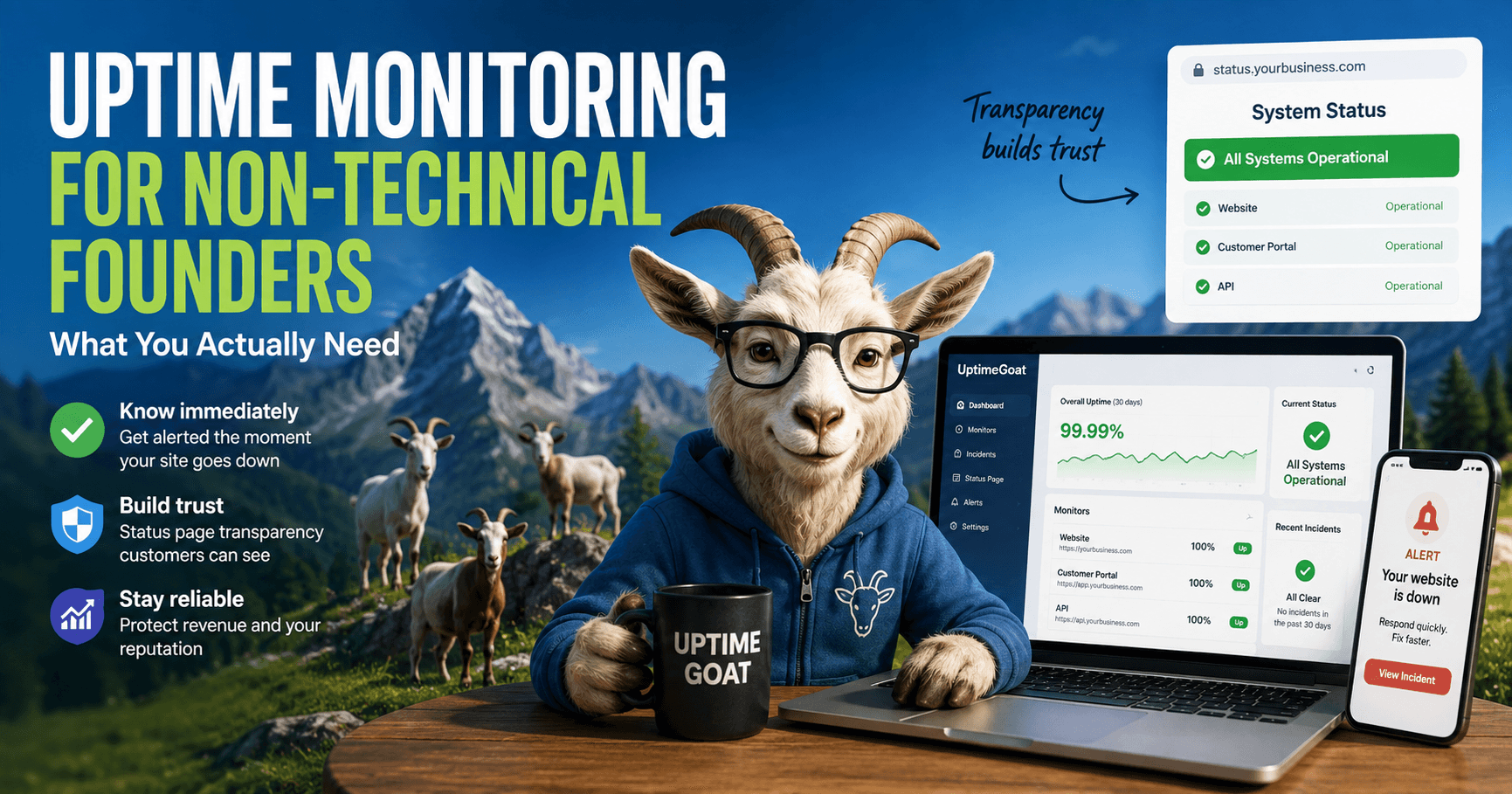
Your website going down costs revenue every minute. Here's what uptime monitoring actually is and why status pages build trust.
Uptime Monitoring for Non-Technical Founders: What You Actually Need
Your website went down on a Tuesday at 3 PM. It was down for 45 minutes. In that time, a customer tried to book a service, couldn't, and called your competitor instead.
You didn't know you were down until someone texted you about it.
What Uptime Monitoring Actually Is
This is the simplest part to explain: uptime monitoring means checking if your website or app is working, automatically, all the time.
A service pings your website every 60 seconds. If it gets a response, you're up. If it doesn't, the service alerts you immediately.
That's it. That's uptime monitoring.
The technical part doesn't matter. You don't need to understand how it works. You just need to know when your site goes down, and you need to know fast.
Why You Should Care
Your website is your business now. It's not a nice-to-have. It's your sales channel, your customer portal, your support hub.
When it's down, you're losing money. Not someday, not eventually. Right now. Every minute it's down is revenue you don't get.
Most small businesses don't monitor uptime at all. They find out because a customer complains. By then, they've been down for 30 minutes, an hour, maybe two.
That's 30 to 120 minutes of lost business because they didn't spend 5 minutes setting up monitoring.
The Status Page Builds Trust
This is the part that matters more than you think.
When you publish a status page—just a simple public page that says "everything is working" or "we're having issues"—customers trust you more.
Why? Because you're being transparent. You're saying "here's what's happening with our service, all the time."
Customers who see a status page believe you're professional, reliable, and honest. Customers who find out your site is down through trial and error believe you're careless.
What Uptime Monitoring Actually Prevents
It's not just about knowing you're down. It's about responding fast.
You get an alert on your phone. You immediately call your hosting company or developer. You get it fixed. 15 minutes down instead of 90 minutes down.
That's the difference between a hiccup and a reputation problem.
For SaaS, consulting, e-commerce, or any business where your website is the customer experience, uptime monitoring is the difference between professional and amateur.
You Don't Need Complicated
You don't need enterprise monitoring software. You don't need a NOC center. You need to know when your site is down, and you need to know immediately.
That's literally it.
UptimeGoat checks your site every minute and alerts you if something breaks. It's straightforward. You get a dashboard showing your uptime history, so you can see patterns. If you go down at the same time every week, that's a signal something is wrong.
Start monitoring today. It takes five minutes to set up and prevents the nightmare of finding out from a customer.
If you're serious about protecting your links, your data, and your brand, it's time to stop sharing raw URLs.
Start using Bilt.ly.
Get started free →