The Hidden Risk in Every URL
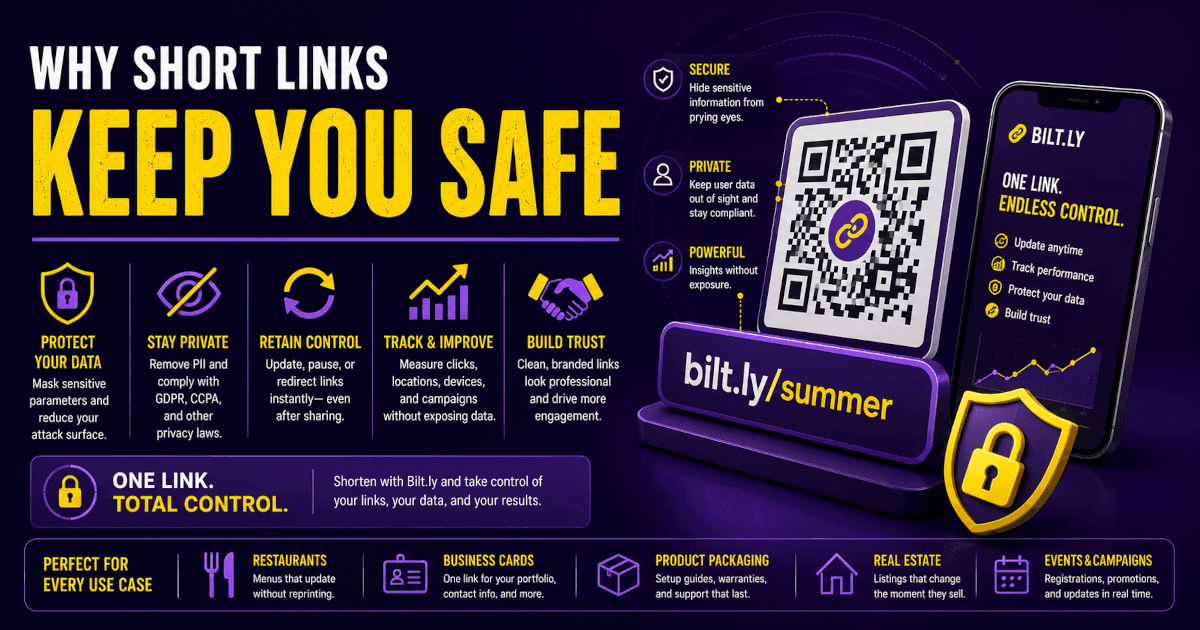
If you're still sharing raw links in emails, texts, or social posts, you're exposing far more than you think. A full URL can reveal your domain structure, tracking parameters, campaign strategy—and in some cases even user identifiers.
If you're still sharing raw links in emails, texts, or social posts, you're exposing far more than you think. A full URL can reveal your domain structure, tracking parameters, campaign strategy, internal page logic—and in some cases even user identifiers. In an era shaped by data scraping, phishing, and tightening privacy regulations like GDPR and CCPA, broadcasting that level of detail isn't just careless—it can become a liability. A clean, shortened link isn't just aesthetic; it's a layer of protection. That's where platforms like Bilt.ly come in.
The Hidden Risk in Every URL
Most people underestimate how much information lives inside a link. Long URLs often include:
- Query parameters (
?user_id=123&campaign=summer_sale) - Folder structures (
/admin/portal/internal/) - Technology fingerprints (
.php,.aspx, etc.)
To a casual user, it's just a messy link. To a bad actor, it's reconnaissance.
Attackers can:
- Map your site structure
- Identify vulnerabilities
- Reverse-engineer campaigns
- Scrape data at scale
Shortening your URLs with Bilt.ly strips away that exposure. Instead of broadcasting your infrastructure, you present a controlled, minimal entry point.
Security Through Abstraction
Think of a shortened link as a buffer between your audience and your backend. When you use a service like Bilt.ly, you:
- Mask sensitive URL parameters
- Prevent easy manipulation of query strings
- Reduce the attack surface of your links
This is especially important in environments where links are frequently shared and reshared—social media, SMS marketing, and email campaigns.
A raw link can be modified. A managed short link gives you control.
Compliance and Privacy Considerations
Regulations like GDPR and CCPA aren't just about storing data—they also apply to how data is transmitted and exposed.
If your URLs contain:
- Email addresses
- User IDs
- Session tokens
…you could be unintentionally violating privacy standards by sharing them openly.
Using Bilt.ly helps you:
- Remove personally identifiable information (PII) from visible links
- Centralize link management
- Maintain cleaner audit trails
For businesses handling customer data, this isn't optional—it's part of responsible data handling.
Control, Flexibility, and Damage Control
One of the biggest advantages of using a URL shortener is control after the link is already out in the wild.
With Bilt.ly, you can:
- Update the destination URL without changing the link
- Disable a link instantly if something goes wrong
- Track engagement and performance
Imagine sending out an email campaign with a broken link. Without a shortener, you're stuck. With Bilt.ly, you fix it in seconds—no resend required.
Trust and Presentation Matter
Long, cluttered URLs look suspicious. Users are increasingly cautious about what they click—and for good reason.
A clean, branded short link:
- Looks professional
- Builds trust
- Improves click-through rates
Instead of:
https://example.com/products/summer-sale?ref=affiliate123&utm_source=email_campaign_2026
You get:
https://bilt.ly/summer
That simplicity isn't just cosmetic—it's persuasive.
Analytics Without Exposure
Modern marketing depends on data, but exposing that data in your URLs is unnecessary.
With Bilt.ly, you can:
- Track clicks, locations, and devices
- Monitor campaign performance
- Optimize without revealing internal metrics
You keep the insights while hiding the mechanics.
The Bottom Line
Every time you share a raw URL, you're giving away more than just a link—you're exposing structure, data, and potential vulnerabilities. In today's digital landscape, that's a risk you don't need to take.
Using a URL shortener like Bilt.ly isn't just about making links shorter. It's about:
- Protecting your infrastructure
- Respecting user privacy
- Staying compliant with regulations
- Maintaining control over your content
It's a small change with a big impact—and one that separates casual sharing from professional, secure communication.
If you're serious about protecting your links, your data, and your brand, it's time to stop sharing raw URLs.
Start using Bilt.ly.
Get started free →