Your Business Is Bleeding Data From Every Link You Send. Here's What That's Costing You.
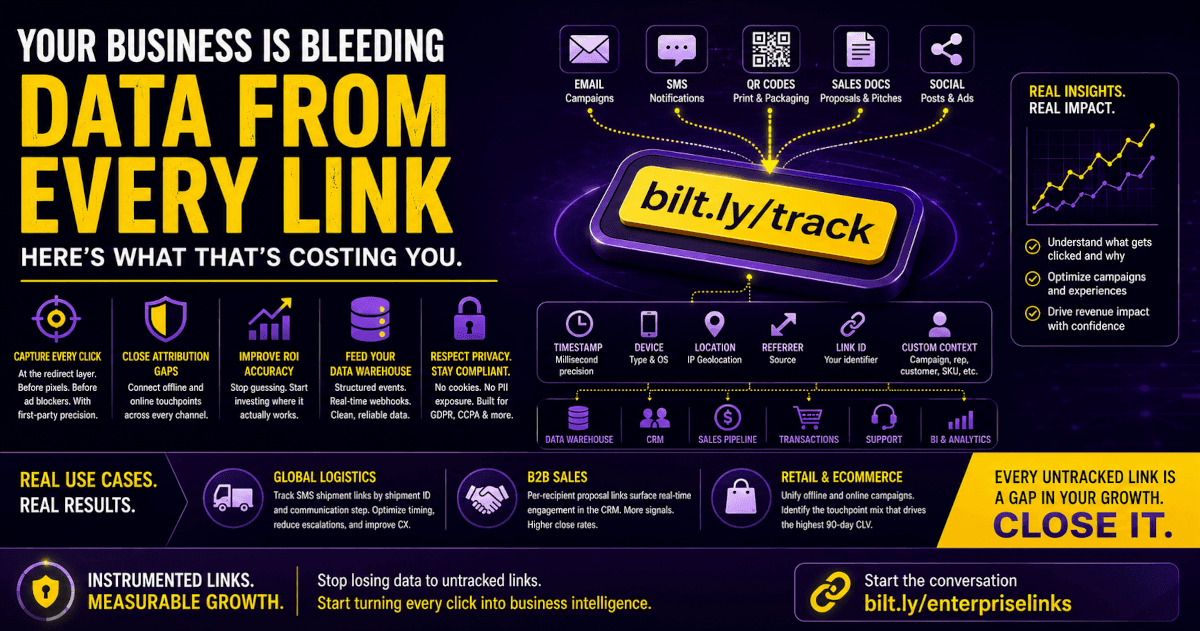
Enterprise teams spend six figures on attribution software and still can't answer basic questions about customer behavior. The signal they're missing fires before their analytics stack even loads. Here's what's actually happening every time someone clicks a link you sent.
Your Business Is Bleeding Data From Every Link You Send. Here's What That's Costing You.
Let's start with a number your CFO would find uncomfortable.
The average enterprise marketing team spends between $40,000 and $60,000 a year on attribution software alone, not counting the ad spend it's supposed to measure, not counting the analysts interpreting the dashboards, not counting the quarterly meetings where everyone debates whether the numbers are even accurate. And after all of that, attribution is still broken. Marketing campaigns suffer because spend gets cut when CMOs cannot prove their return on investment.
The irony is that one of the most reliable, highest-fidelity behavioral signals in your entire customer journey is sitting uncaptured inside something your organization already uses every day.
Every link you send is a data event. You just aren't treating it like one.
What a Click Actually Is
When a customer clicks a link, whether it's in an email, an SMS, a printed QR code on product packaging, a proposal shared by a sales rep, or a social post, that click fires before your destination page loads. Before your analytics script runs. Before your pixel fires. Before the ad blocker has anything to block.
It contains the timestamp to the millisecond, the device type and operating system, the geographic coordinates tied to the IP, the referral source, and critically, the exact link identifier that was clicked. That identifier can be tied to any data point you choose at the time of link creation: a specific customer ID, a campaign code, a sales rep, a physical location, a product SKU, a communication sequence step.
That is not a vanity metric. That is a behavioral event with full customer context attached, and it exists completely independent of what happens on the destination page.
The Gap Your Current Analytics Stack Cannot Close
Your web analytics only see users who complete a page load and execute JavaScript. Your email platform only tells you that someone in a segment opened a message and possibly clicked. Your CRM has no idea what a prospect did after your sales rep sent them a case study. Your paid media dashboards have been increasingly blind since iOS privacy changes began stripping mobile attribution data years ago.
Disconnected marketing and sales data across multiple systems create attribution blind spots and make it impossible to establish a single source of truth. Unreliable campaign ROI data impacts pipeline development and revenue generation.
A URL shortener API, integrated properly into your data infrastructure, closes that gap. Not because it's magic, but because it captures at the redirect layer, a place that none of your existing tools are watching, with first-party precision that no cookie restriction, browser update, or privacy regulation can touch.
What This Looks Like at the Organizational Level
A global logistics company embeds unique short links into every SMS shipment notification. Each link is generated at dispatch, tied to the shipment ID, the recipient record, and the communication sequence. When a customer clicks, that event pushes to the data warehouse in real time. Operations now knows, at scale and without a survey, which shipment status communications actually get read, which ones generate follow-up inbound calls, and at what point in a delay customers start escalating. That is operational intelligence that changes staffing models, communication timing, and customer experience strategy. None of it comes from a dashboard inside a URL shortener. It comes from that click data living where your other operational data lives.
A B2B sales organization generates per-recipient proposal links for every document sent by every rep. When a CMO-level contact clicks the pricing section of a proposal at 10pm on a Tuesday, that event surfaces in the CRM contact record immediately, tagged to the deal stage, the rep, and the specific document. The sales team is not checking a link dashboard. The signal is waiting for them inside the tool they already live in. Close rates on accounts with three or more tracked link engagement events are measurably higher than accounts with zero.
A consumer retail brand running omnichannel campaigns encodes short links into every print ad, every email, every SMS, and every social post. Each link carries a channel tag, a campaign ID, and a creative variant identifier. All click events flow into the data warehouse alongside transaction records. For the first time, the CMO can answer the question that has eluded them for years: which specific combination of offline and online touchpoints in what sequence produces the highest 90-day customer lifetime value?
That question cannot be answered by any single platform. It can only be answered by joining datasets, which only works when click data lives in your infrastructure alongside everything else.
The Architecture Question Most Organizations Get Wrong
Treating a URL shortener as a platform where you log in and check dashboards is the wrong mental model for an organization serious about data. The right model is treating every link click as a structured event that belongs in your data warehouse, joined to your CRM records, your transaction data, your support ticket history, and your campaign spend.
That requires webhook infrastructure so click events push to your systems the moment they occur. It requires a defined schema so click events have consistent field structure when they land. It requires a deduplication strategy because bot traffic at scale can represent 30 to 40 percent of raw clicks. And it requires analytics data retention measured in years, not the 30-day window most entry-level API tiers offer, because the questions worth asking about customer journey patterns cannot be answered in a 30-day window.
What This Is Worth
2026 is the year CMOs are being forced to prove marketing's true contribution, not just clicks and conversions, but actual revenue impact. A properly instrumented link layer does not replace your attribution platform. It feeds it. It gives your attribution model first-party signal that no pixel, no cookie, and no consent dialog can interrupt. It connects your offline touchpoints, your printed materials, your physical locations, your sales team's outreach, to the same data infrastructure where your digital performance lives.
The companies building this are not doing it because URL shorteners are interesting. They are doing it because every untracked link is a gap in their understanding of how customers actually behave, and in 2026, gaps in customer understanding cost money.
Ready to Close the Gap?
The infrastructure to fix this is not as complex or expensive as it sounds. The API integration is straightforward. The schema design is a one-time exercise. The meaningful work is deciding what you want to know, designing the link taxonomy to capture it, and routing the events into the systems where your team already makes decisions.
The team at bilt.ly builds exactly this kind of instrumented link infrastructure.
Start the conversation at bilt.ly/enterpriselinks
If you're serious about protecting your links, your data, and your brand, it's time to stop sharing raw URLs.
Start using Bilt.ly.
Get started free →